As higher education practitioners, we consistently speak about increasing access and narrowing the education gap, with a focus on summer schools, access schemes, and bursaries. However, there is a less spoken-of issue facing today’s students – the digitisation of the university application process. The postcode lottery has not disappeared; a new challenge has emerged for those from under-resourced backgrounds.
The Postcode Lottery
The Postcode lottery was perceived as a significant factor contributing to a child’s academic success; those living in the right postcodes have access to high-performing schools, while those living in areas of high deprivation are left with underperforming schools as their only option. This is an issue that has fed into itself over time. Higher performing schools attract more experienced teachers, the school’s results improve, meaning parents move into the area to send their child there. This thereby increases the demand for housing and the value of homes in the area, pricing certain families out of a high standard of education.
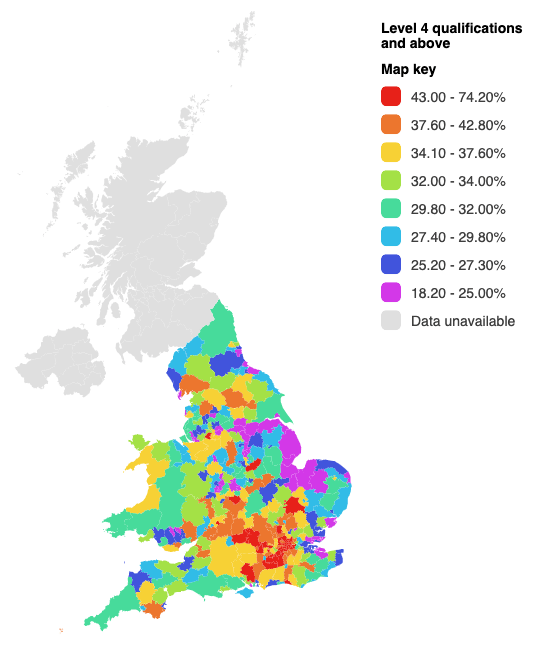
The postcode lottery is still very real and has a drastic effect on under-resourced students. According to the 2021 census, geographic location significantly impacts the likelihood of a person holding higher qualifications through university or otherwise. This map effectively illustrates the postcode lottery. The City of London has 74.2% of the population holding level 4 or above qualifications, while 21% of adults in the West Midlands have no qualifications at all. Those who happen to be born in certain areas are up to four times as likely to access higher education. As stated by the Sutton Trust, this is important to note when considering university access, as a parent having previously attended university largely influences the likelihood of their children gaining access to higher education, a double disadvantage, as these parents are most likely to be able to provide access to premium hardware.
The Digital Shift
The medium for social mobility is transitioning from the classroom into the online world. Although the postcode lottery still has a significant impact, we have seen the growth of a new factor affecting students – digital access. Following the COVID-19 pandemic, we have seen a global shift towards the online world, and digital access is becoming an ever-increasing need.
The university application process has followed suit; high-stakes moments in a student’s application process, such as virtual open days, interviews, or entrance exams, can hinge on a student’s ability to not only access a device, but to have a strong and reliable internet connection too. There is a lack of support for these students, likely resulting from gaps in the understanding of a student’s experience. In supporting students in the transition into this digital landscape, initiatives seem to focus on only one part of the issue; we need to ensure both internet connectivity and digital capability. Project Gigabit aims to have 85% of the UK connected via fibre, but how does this help a student whose parents are unable to afford the £25 a month to pay for the service? As shown in research from citizens advice, the cost of living crisis develops, so does the number of households priced out of an internet connection. The Department for Education’s “get help with technology scheme” has given 1.3 million laptops to students in the UK, but giving a student a laptop who has no internet access is like providing a textbook in a language the student has not been taught to read – the tool exists, but access is just out of reach.
We are judging academic potential based on bandwidth
We can no longer focus on only one aspect of digital access, as students are left with only half a problem resolved. To create an equitable application process, students need to have a stable internet connection as well as a laptop. Post COVID- 19 universities have switched almost entirely to digital-first recruitment, components of this ranging from digital tours, online interviews and digital tours. Although this may streamline the process for universities, where does this leave students without access to digital connectivity and capability? A study conducted by Jisc evidences a clear gap in digital agency, students from under-resourced backgrounds are less confident in navigating digital first portals. Universities often do not hold an “offline contingency” plan and assume a stable environment for students partaking in interviews or open days. For students without stable access, they can be deemed as unprofessional or having a lack of engagement as a consequence of digital precarity. We are judging academic potential based on bandwidth.
Breaking Through the Digital Barrier
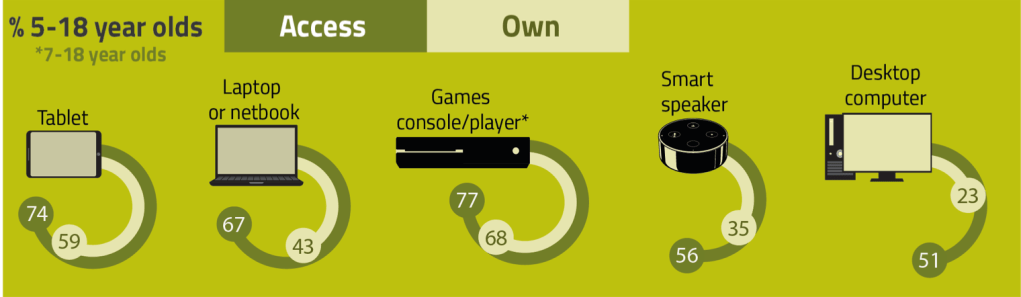
Current policy has a binary attitude towards digital access, either a student has or hasn’t got it. As with all things in education, this is not a black and white issue; a student can have access to the Internet at their address, but their family may not pay for a fibre connection. A student can have a mobile device, but it is an old phone with a cracked screen and broken camera, or a laptop that is shared between all members of their family, as shown in the above OFCOM chart. This has now become an added disadvantage that under-resourced students face, in comparison to their peers who may have their own phone, laptop and tablet they are able to use to support their school work, revision and now their university application too.
As higher education practitioners, we must work to raise the profile of this issue so that digital access is now treated as a utility for education, like a textbook or calculator. There is no longer a way for a student to participate in the university application process without discrimination if they do not have a strong internet connection and a laptop. This is an issue that needs to be tackled not only within our practice but within governmental and university policy, so we can ensure students are measured by their academic capabilities not their bandwidth.
 The Social Context
Leave a comment